Climate: adaptation finally proves its profitability, up to €13 for every €1 invested.
NEWS
A global study demonstrates the profitability of climate adaptation: up to €13 in benefits for every €1 invested
For several years, it has been said that every euro invested in climate change adaptation returns between 8 and 13 euros in benefits, without really knowing whether it is a pious wish or a concrete and measured economic reality. Tangible, quantified, and scientific evidence was lacking to demonstrate that this ratio is not just a slogan but a measurable and reproducible economic result.
This has now been achieved.
A study published in 2025 by the World Resources Institute (WRI) finally provides tangible and quantified evidence: adaptation is not a cost, but a highly profitable investment.
Based on more than 320 projects carried out in 12 countries, this analysis shows that on average, every dollar invested generates $10.50 in benefits, with a return on investment (ROI) of about 27%.
Remarkably, a significant portion of these benefits occurs even without extreme climate events. In other words, adapting means investing in economic performance, competitiveness, and long-term stability.
Three benefits (“dividends”) that change the perception of adaptation
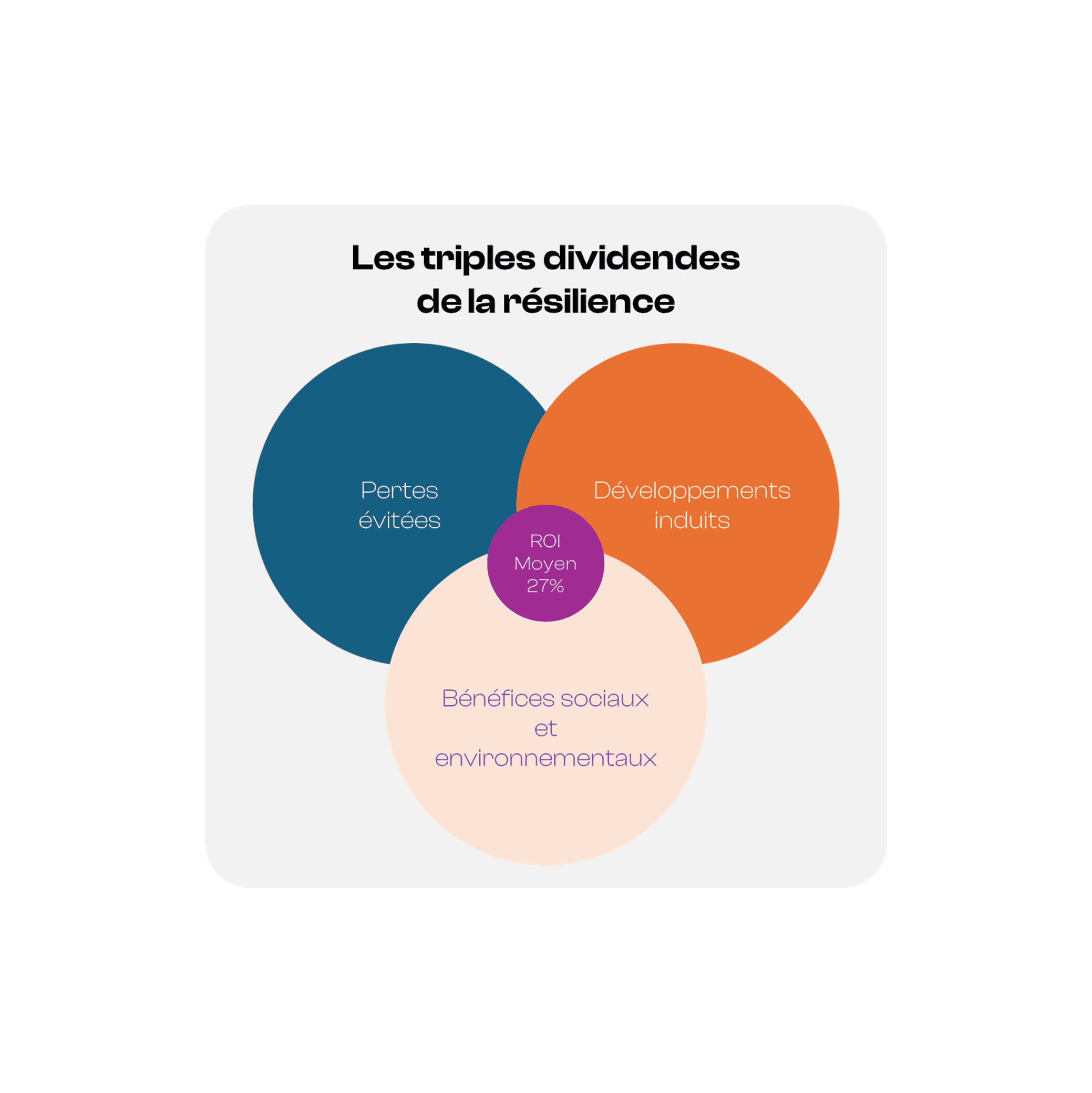
The analysis framework of the Triple Dividend of Resilience (TDR), developed by the WRI, shows that the benefits of adaptation have been largely underestimated until now.
Too often, economic analyses only account for avoided losses, such as protected infrastructure against flooding. But the other two economic, social, and environmental benefits often represent double the initial gains.
The WRI’s analytical framework is based on three levels of dividends:
· Dividend 1: avoided losses – reduction of material damage, crop losses, and business interruptions.
· Dividend 2: induced development – increased productivity, job creation, land value appreciation, maintenance savings, increased attractiveness for investors.
· Dividend 3: social and environmental benefits – improved health, poverty reduction, carbon sequestration, biodiversity preservation, collective well-being.
On average, more than half of the benefits of evaluated projects do not depend on the occurrence of a climate hazard. This is a major finding: adaptation becomes a strategy for sustainable performance, not a defensive expense.
Concrete and measurable returns on investment
The WRI relies on real projects funded by the World Bank, the Asian Development Bank, and the African Development Bank. These projects cover various sectors (agriculture, health, energy, urban infrastructure) and demonstrate that the economic benefits far exceed the initial costs.
Adaptation and mitigation: the winning combination
Nearly half of the projects analyzed have co-benefits for emissions reduction, paving the way for hybrid financing mechanisms: adaptation funding, carbon financing, public-private partnerships.
The WRI shows that projects combining adaptation and mitigation are the most attractive for investors: they enhance operational stability while improving the extra-financial profile. The economic benefits known as "second dividend" — increased productivity, jobs created, purchasing power — provide a solid foundation for private investment. In other words, adaptation ceases to be an environmental expense: it becomes a driver of competitiveness and growth.
Adaptation: a strategic and measurable investment
The WRI study finally provides empirical data to support the ROI ratios highlighted by numerous sources (McKinsey & Co., OECD, Swiss Re Institute, WEF, US Chamber of Commerce, Government of Canada).
The results from 320 adaptation measures are telling:
· Average ROI: 27 %
· Benefit: $10.5 per dollar invested
· Positive effects observed even without catastrophe
· Alignment with the SDGs and ESG criteria
The WRI study evaluates these benefits across four dimensions:
· physical damages,
· financing,
· productivity,
· and overall ROI.
Adaptation measures lead to a reduction in direct losses and downtime, better insurability, and lower financing costs, as well as performance gains related to operational continuity and improved working conditions.
In other words, failing to adapt costs much more than taking action. Adaptation becomes a pillar of economic, social, and environmental performance. American businesses and communities have already integrated this: according to the Tailwind report (2024), investments in adaptation have been 23 times higher in the United States than in Europe. Organizations that invest today in their resilience secure their profitability, reduce their cost of capital, and enhance their sustainable attractiveness.
Main sources
· Brandon, C., Kratzer, B., Aggarwal, A., Heubaum, H. (2025). Strengthening the Investment Case for Climate Adaptation: A Triple Dividend Approach. World Resources Institute.
· McKinsey & Company (2020). Climate risk and the opportunity for real estate.
· Organisation for Economic Co-operation and Development (2024). Infrastructure for a Climate-Resilient Future: Principles and Policy Recommendations. OECD Publishing.
· Swiss Re Institute (2023). Climate adaptation: Building resilience, rebuilding value. Zurich: Swiss Re Ltd.
· World Economic Forum (2024). The Cost of Inaction: A CEO Guide to Navigating Climate Risk. Geneva: WEF.
· World Resources Institute (2025). The Compelling Investment Case for Climate Adaptation.
· U.S. Chamber of Commerce & Allstate Foundation (2024). The Preparedness Payoff.
· Government of Canada & Canadian Climate Institute (2024). News release: For every dollar spent on adaptation measures today, $13–15 will be returned in the years ahead.
· Tailwind (2024). The Adaptation & Resilience Innovation Playbook.