Jan 6, 2026
Climate disasters: the hidden side of economic losses
NEWS
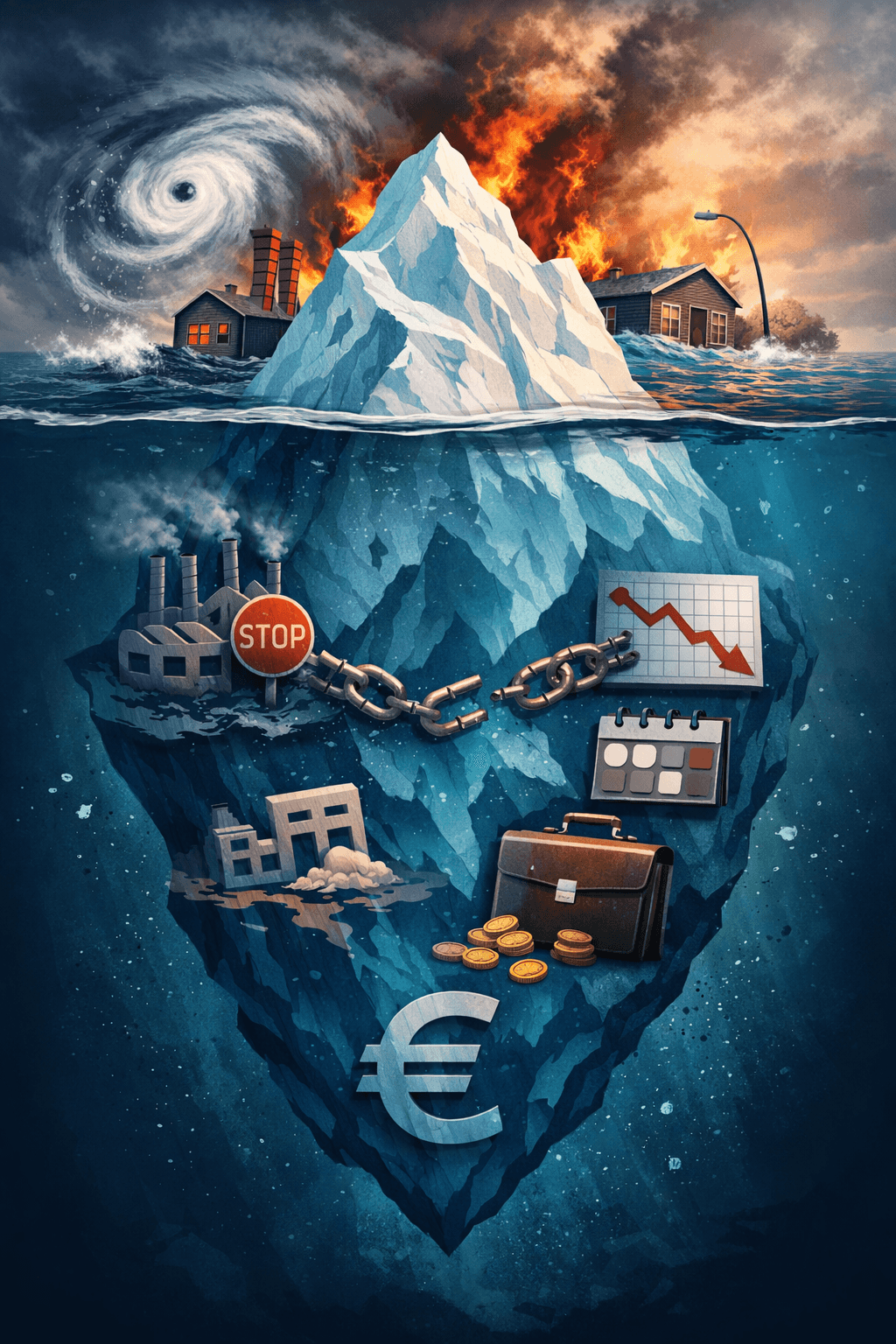
Climate Disasters: What the Numbers Don't Tell Us.
Every year, reports on climate disasters make the headlines[i].
In 2025, several reports highlighted a decline in the global bill, which is still over 200 billion dollars, but decreasing compared to previous years. At first glance, good news.
However, a closer look reveals that this interpretation is misleading. These numbers, impressive as they may be, only measure a very limited part of the economic reality of climate disruptions.
Insured Losses… Not Real Losses
The first major bias: the amounts highlighted mainly correspond to insured losses, that is to say the compensations paid by insurers and reinsurers. They do not reflect the total economic losses suffered by businesses, communities, and households.
The following are largely absent from these reports:
uninsured damages,
deductibles,
compensation caps,
business interruption losses,
activity interruptions,
restart costs,
or indirect losses along the value chains.
Yet, on a global scale, almost half of the losses related to climate disasters are not covered by insurance. This "insurance gap" is well documented by reinsurers and international institutions, and it is often even higher for small businesses.
In other words, one euro of insured loss often hides another, very real euro, invisible in the statistics, but very visible in the cash flows of companies!
An Ever More Restrictive Insurance Context
The second key element: the insurance context itself is evolving rapidly, which skews comparisons from one year to the next.
For several years now, we have observed:
a marked increase in deductibles,
increasingly capped compensations,
the exclusion of certain perils in multi-risk contracts,
a highly differentiated pricing based on areas and profiles,
or even the complete withdrawal of insurance in certain regions or for certain insured parties.
In this context, an apparent decrease in insured losses does not necessarily mean a decrease in climate impacts. It may also reflect a more worrying reality: an increasing share of the damages is simply no longer insurable.
A Persistent Underlying Trend
Climate change cannot be analyzed from one year to another but rather over several years at a minimum. The figures are quite clear: annual fluctuations do not undermine the long-term trend. Over the last twenty years, the cost of climate disasters has increased on average by 5 to 7% per year.
This structural increase is explained by the combination of several well-known factors: intensification of events, urbanization, concentration of exposed value, and increased dependency of economies on infrastructure and logistics chains.
In other words, physical climate risk is not declining. It is transforming, spreading, and taking root in the real economy.
The Tip of the Iceberg
Hurricanes, giant fires, or major floods make the headlines. But they are only the tip of the iceberg.
However, every year, there are millions of local climate events — heat waves, droughts, late frosts, urban runoff, strong winds — that quietly affect businesses.
These events are rarely covered by the media. Yet their consequences are severe.
Studies show that nearly 40% of small and medium-sized enterprises affected by a major climate event shut down permanently when they are neither prepared nor supported.
Climate risk is therefore not only spectacular. It is diffuse, daily, and deeply economic.
Adaptation Is No Longer an Option
In this context, one obvious fact is emerging: insurance cannot be the only response. It will not work indefinitely for those who do not invest in prevention or adaptation.
The major risk is no longer the climate event itself, but inaction: not anticipating, not measuring, not deciding. Adaptation thus becomes a strategic necessity, just like managing financial, industrial, or operational risks.
From Knowledge to Action
To act, one must first know.
Know where the risks are located, how they are evolving, and especially what they really cost.
This is the whole point of new approaches that aim to translate physical climate risks into understandable and actionable financial terms: expected losses, activity interruptions, cost of inaction, return on investment for adaptation.
For it is under this condition — deciding in euros to act — that adaptation ceases to be perceived as a constraint and becomes a lever for resilience and value creation.
In Summary
The figures on climate disasters are essential.
But taken in isolation, they can give an illusion of control.
Insured losses tell only part of the story.
The economic reality of climate risk is broader, more diffuse, and already very present.
In a world where hazards are intensifying and insurance is retracting, anticipation and adaptation are no longer a luxury. They have become a condition for economic survival, but also — and above all — a strategic opportunity to create value in a more uncertain world.
[i] How much do climate change disasters cost in 2025?
The top 10 climate disasters cost the world billions in 2025.
https://www.christianaid.org.uk/news/policy/how-much-do-climate-change-disasters-cost-2025