Adapting businesses to the climate of tomorrow with yesterday's scenarios: a systemic error
NEWS
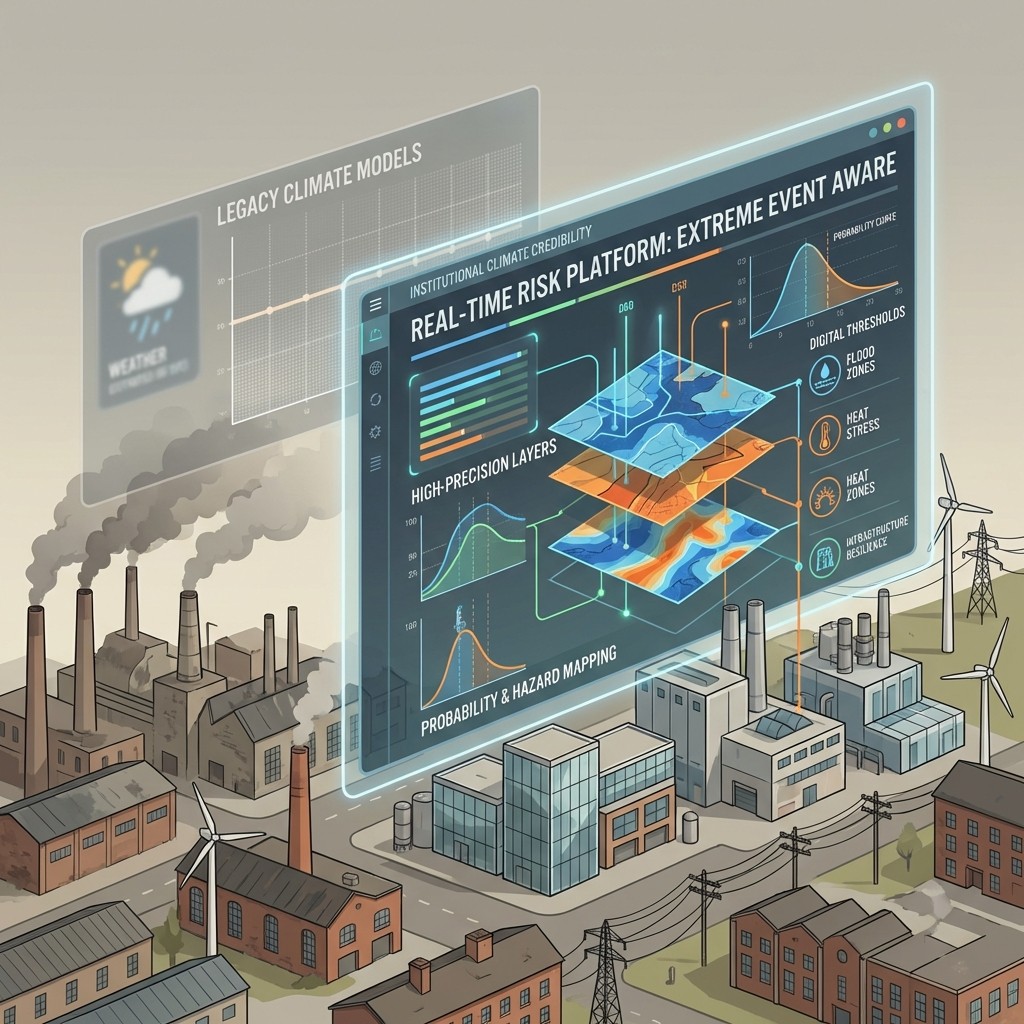
RCP, SSP: when bad climate scenarios threaten businesses, employees, and public money
For several years now, a consensus seems to have been reached: it is necessary to adapt to climate change. Companies are encouraged to conduct diagnostics, local authorities to plan, and the state to finance. Tools are multiplying, and platforms are too. However, a fundamental problem remains largely ignored: the quality and relevance of the climate scenarios used to guide these decisions.
Two acronyms systematically appear in these efforts: RCP and SSP. They are omnipresent in diagnostics, calls for projects, and support systems. They are often cited, rarely explained, and almost never questioned. However, their misuse is not a matter of academic debate. It leads to incoherent decisions, unnecessary investments, sometimes dangerous, and to a very poor use of public funds.
Companies are not climatologists and shouldn't have to be
First, it is important to recall an often-forgotten truth : companies and organizations are not climate specialists. Their role is not to master climate modeling but to run stores, factories, warehouses, to ensure safe working conditions, and to protect their customers, employees, and assets. They naturally do what any rational organization does: they rely on their partners to be experts in their place.
When solutions are proposed by recognized institutional actors, labeled "blue-white-red", sometimes partially or fully funded by public funds, and disseminated by the professional associations they belong to, companies have no reason to doubt. They have no reason to lift the hood, question the data chain, or wonder if the underlying assumptions are actually suited to the pursued objective: to understand their risks and adapt to protect their users, employees, and activities.
No one would buy a car with a engine that is over 20 years old
Buying a climate diagnostic today that relies on obsolete or incomplete data is a bit like buying a new car made with parts designed decades ago. No one would imagine that engine parts are used or more than twenty years old. No one would accept that the braking system was designed for traffic from another century or that some critical components were removed. And yet, this is exactly what happens when, in 2025, we use diagnostics based on climate scenarios built at the beginning of the 2010s and calibrated on historical data that stops in the mid-2000s.
RCP and SSP: Why these scenarios are fundamentally different
The RCPs, introduced by the IPCC in the early 2010s, had a precise and legitimate function: to provide climate models with trajectories of greenhouse gas concentration, expressed in radiative forcing by 2100. They describe a global physical outcome. They do not describe societies, nor political choices, nor economic conditions. They do not integrate the vulnerability of territories, nor the evolution of uses, nor adaptation capacities. They were designed for climate research, not to arbitrate investments on a real site or to secure working conditions.
In response to these limitations, the scientific community has developed SSPs, integrated into the sixth IPCC report. The SSPs describe complete socio-economic trajectories: governance, urbanization, inequalities, technologies, adaptation capacity. On paper, they are therefore far more relevant for thinking about adaptation. Yet, they need to be truly used, and correctly.
Outdated scenarios used without critical thinking
In practice, a large portion of the adaptation diagnostics conducted today in France rely on the climate data made available by DRIAS, which means climate futures according to RCP. This data feeds almost all public and semi-public tools: state platforms, insurer and bank tools, ADEME or Bpifrance systems. All use the same climate bricks from DRIAS.
However, it only takes a moment to examine these data chains to find that the historical climate data used stops around 2005, that the last twenty years, marked by a sharp acceleration in extreme events, do not structure the models, that the scenarios used are mostly RCPs from AR5, and that major threats are absent or very poorly modeled.
Flooding from runoff, responsible for the majority of natural disaster decrees in Île-de-France and to which one in five French people is unknowingly exposed, is the most striking example.
In other words, we are trying to adapt the world of 2025 with climatic assumptions from 2005.
When reality exceeds scenarios
Meanwhile, reality has significantly outpaced the scenarios. Since 2010, the observed trajectory corresponds to scenario SSP5-8.5, not to intermediate or optimistic trajectories. In France, warming already exceeds +2 °C. So-called "exceptional" events have become recurrent. Production losses, temporary or permanent closures, supply chain disruptions are multiplying, healthcare costs and working conditions are deteriorating.
Diagnostics that falsely reassure
In this context, continuing to rely on smoothed climate averages and horizons of 2050 or 2100 to make decisions today is not only inconsistent. It is potentially dangerous.
The consequences are well known: investments directed towards the wrong sites, undersized protections, disasters labeled as "unpredictable" when they were foreseeable, accelerated depreciation of assets, massive and lasting operational losses. Runoff flooding, absent from many diagnostics, nevertheless causes prolonged closures and critical social situations. The risk was not unpredictable. It was poorly anticipated.
The problematic role of public funding
The most concerning point relates to the role of public funding mechanisms. Companies trust mechanisms supported by ADEME or Bpifrance. They dedicate time to them, mobilize their teams, consume subsidies. But when diagnostics rely on obsolete scenarios, absent threats, self-assessment questionnaires, and a strictly national vision, no robust decision can come out of it, especially on global supply chains.
The result is paradoxical and deeply problematic: the company thinks it has acted, funders think they have used public money well, professional associations and unions think they are providing a service, and employees as well as organizations remain exposed. The worst is not the mistake. The worst is the illusion of protection.
What every company should demand before launching a diagnostic
It is time to draw a simple lesson from this situation. Before investing time in a climate diagnostic, and even more so when it is free or almost free, every organization should ask a few basic questions. What is the source of the data? What is its geographical accuracy? What threats are not taken into account? Do the data allow for the analysis of the entire value chain, including outside of France? If the answers point to non-updated RCP scenarios, the exercise is pointless. If major threats like runoff are absent, the surprise will come on the day of the disaster.
Conclusion
RCP and SSP are not interchangeable acronyms. They embody methodological choices that impact the safety of people, the sustainability of businesses, and the use of public money. Adaptation can only be seriously guided with up-to-date data, scenarios consistent with observed reality, an explicit consideration of extremes, and a clear understanding of the limits of adaptation itself.
No one will blame a company, a leader, or a manager for a climate event happening.
However, what will be increasingly criticized is not the event itself, but the failure to see it coming, the lack of preparation, the failure to act, even though the tools and knowledge existed, provided the right tools were used !
Relying on institutional mechanisms labeled "blue-white-red", partially or fully funded by public funds, sometimes gives the reassuring feeling that there is no risk. A form of cover my ass strategy collective emerges: the diagnostic has been done, the box has been checked, responsibility seems diluted.
But when the climate event occurs, it is neither boxes nor reports that are impacted. It is people, employees, clients, businesses that stop, sometimes permanently. At that moment, the question will not be: "who could have predicted?" The question will be much simpler, and much more brutal:
how could we have committed time, public money, and human resources to an exercise that did not integrate all the risks, that relied on dated assumptions, and that gave an illusion of protection?