Managing climate risks in a less insurable world: why choose an independent expert?
NEWS
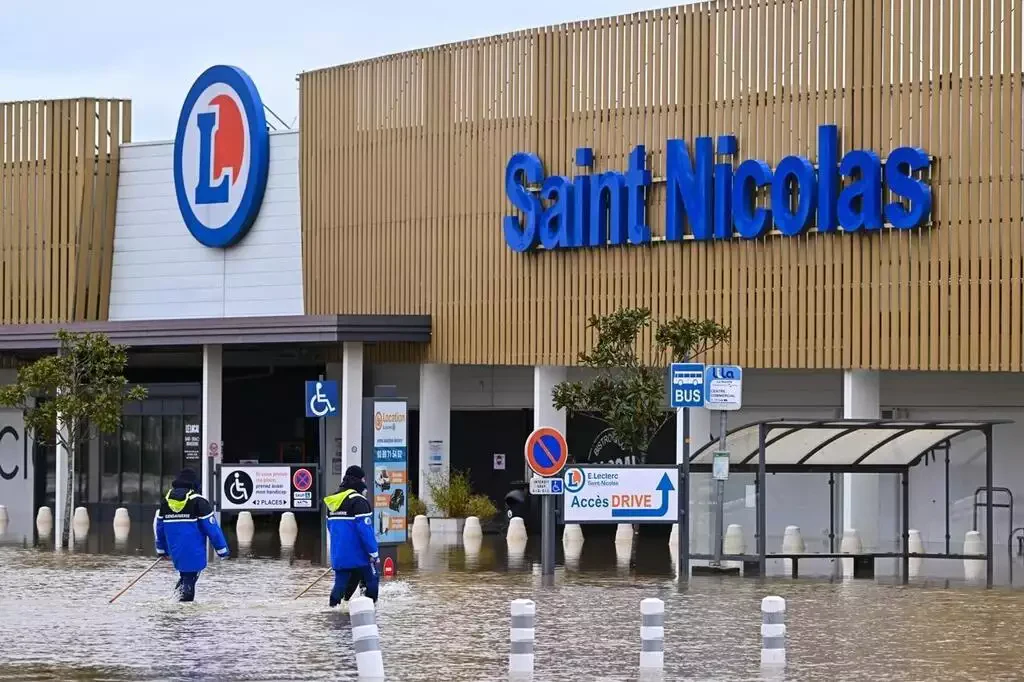
In a world where climate change is profoundly transforming our economic environment, the question is no longer whether your organization will be impacted, but when and how !
Floods, droughts, heatwaves: these extreme events are multiplying and making some assets simply uninsurable. In light of this reality, the choice of your partner for assessing and managing your climate risks becomes strategic.
Climate Risk Management: A Methodical Approach
Like any operational risk, climate risk management follows a proven methodology:
Precise identification of risks
Quantification of their potential impact
Development of an appropriate management policy
Implementation of concrete reduction strategies
Continuous validation and updating of exposures
This rigorous approach requires sharp expertise and, above all, unwavering objectivity.
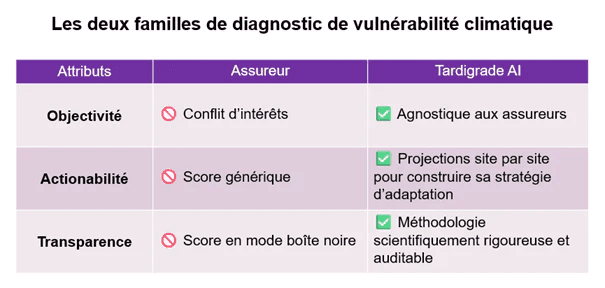
However, today, many organizations are turning to their insurers to carry out their climate exposure assessments. This practice raises a fundamental question: can one be both judge and party?
The Conflict of Interest at the Heart of the Current System
Imagine for a moment:
Would you accept a certified organic label from the company that manufactures the product?
Would you trust a study on the harmfulness of a product funded by its manufacturer?
Would you follow the recommendations of a financial advisor who only offers the products that pay them?
The answer seems obvious. Yet, this is exactly what happens when an insurer assesses your climate risks and then uses that same information to adjust your premiums, modify your coverages, or decide not to insure you anymore.
The Gradual Demutualization of Climate Risks
The fundamental principle of insurance is based on the mutualization of risks. However, we are observing a concerning trend: insurers apply demutualization when it comes to excluding the most exposed assets while maintaining mutualization to increase premiums for all insured parties. Many municipalities can no longer find an insurer or see their calls for tenders go unanswered. Businesses and individuals face increasing refusals of coverage.
This situation is all the more worrying as the Caisse Centrale de Réassurance (CCR) plans to create an "Observatory of Insurability" which, paradoxically, could accelerate the phenomenon of uninsurability by identifying more and more risk zones.
Let us remember that the CatNat regime in France is based on a principle of national solidarity: all insured parties contribute to financing through a mandatory surcharge on their contracts, and the state assumes a significant part of the risk through the CCR. The insurer is thus not alone in bearing the financial burden of natural disasters.
Independence: A Guarantee of Objective Analysis
In the face of these challenges, the climate exposure and vulnerability assessment becomes an essential strategic tool. It not only allows you to anticipate potential damages but also to adopt preventive measures tailored to each specific situation.
The crucial question then becomes: who should undertake this mission?
Your insurer, who has a direct economic interest in assessing your risks?
Or an independent expert, whose sole mission is to provide you with an objective analysis and concrete solutions?
Tardigrade AI: Independent Expertise at the Service of Your Resilience
It is to meet this need for independence and expertise that Tardigrade AI has developed, in direct collaboration with businesses, the first truly actionable climate vulnerability assessment.
Our approach stands out for:
Total independence from the insurance sector
A rigorous scientific methodology
Concrete recommendations tailored to each identified risk
A global coverage of climate risks
Custom adaptation solutions for each organization
Preparing for the Future in a Less Insurable World
In a context where insurability becomes a major issue, anticipating and adapting to climate risks is no longer an option, but a strategic necessity. Organizations that can implement effective adaptation strategies, based on independent and rigorous assessments, will be the ones that turn this constraint into a competitive advantage.
General managers, risk managers, CSR directors: adapting to climate change is now a pillar of your organization's sustainability. Do not let those who have an interest in overestimating your risks dictate your adaptation strategy.
Contact Tardigrade AI to discover how our independent expertise can help you build true climate resilience, beyond simple scores and biased assessments.
Frequently Asked Questions
What is an agnostic climate vulnerability assessment, and how does it differ from an evaluation carried out by an insurer?
An agnostic climate vulnerability assessment is a comprehensive analysis of climate risks conducted by an expert with no ties to the insurance sector. Unlike an insurer's assessment, which may be influenced by commercial interests (premium adjustments, coverage modifications), an independent assessment like the one offered by Tardigrade AI guarantees total objectivity. Our rigorous scientific methodology precisely identifies your vulnerabilities and provides concrete recommendations without conflicts of interest.
How does the phenomenon of climate uninsurability affect businesses, and how can they prepare effectively?
Climate uninsurability—a situation where certain assets become impossible to insure due to their exposure to climate risks—intensifies with the increase of extreme events. Businesses face coverage refusals, higher deductibles, or specific exclusions. To prepare effectively for this, it is essential to:
1. Carry out an independent vulnerability assessment.
2. Implement targeted adaptation measures.
3. Diversify your risk transfer strategies beyond traditional insurance.
4. Integrate climate resilience into your long-term strategic planning.
What are the most common climate risks for organizations, and how can they concretely impact operations?
Major climate risks include floods, droughts, heatwaves, storms, and coastal submersions. Their concrete impacts on operations are multiple: damage to infrastructure and equipment, business interruptions, disruptions in supply chains, increased energy costs, difficulties in access for employees and clients, and impacts on the health and productivity of staff. These risks can also affect your reputation, your legal and regulatory obligations, and your ability to obtain funding or insurance.
How can I evaluate the return on investment of climate adaptation measures for my organization?
The ROI of climate adaptation measures is calculated by comparing implementation costs with expected benefits. These benefits include: reducing direct and indirect losses related to claims, savings on insurance premiums, avoiding business interruptions, preserving asset value, and competitive advantages. Tardigrade AI quantifies these elements in its assessment, allowing for prioritization of investments according to their effectiveness. Our approach projects risks and benefits over several decades, taking future climate scenarios into account for accurate and scientifically-based ROI calculations.
What is the difference between climate change mitigation and climate adaptation, and why should my business invest in both?
Mitigation aims to reduce greenhouse gas emissions to limit the extent of climate change, while adaptation involves adjusting your operations and infrastructure to cope with the already inevitable climate impacts. Your company should invest in both approaches because:
· Mitigation responds to rising regulatory requirements and stakeholder expectations.
· Adaptation protects your assets and operations against existing risks that will intensify.
· An integrated approach often creates synergies and co-benefits.
· Both strategies are necessary to ensure the long-term viability of your organization in a climatically unstable world.
How does Tardigrade AI's scientific methodology differ from other climate risk assessment approaches?
Tardigrade AI's methodology stands out due to four major innovations:
1. A site-by-site analysis at GPS coordinates rather than generic scores, incorporating the local specifics of each asset.
2. The use of high-resolution spatial and temporal climate models, calibrated on the latest scientific data.
3. A multidimensional approach that assesses not only exposure to hazards but also the specific sensitivity of your assets and your adaptive capacity.
4. Actionable recommendations, prioritized and accompanied by detailed cost-benefit analyses. This scientific rigor ensures precise and actionable results, unlike standardized market approaches.
Which economic sectors are most vulnerable to climate risks and why?
The sectors most vulnerable to climate risks include:
1. Agriculture and agri-food, directly impacted by changes in temperature and precipitation.
2. Real estate and infrastructure, exposed to extreme events and devaluation related to climate risks.
3. Tourism, sensitive to changes in climatic conditions and ecosystem degradation.
4. Energy, facing production and distribution challenges during extreme events.
5. Transportation and logistics, vulnerable to infrastructure disruptions. Each sector presents specific vulnerabilities that Tardigrade AI analyzes in detail, offering a deep understanding of the risks particular to your industry and organization.
How can I effectively integrate climate resilience into my overall business strategy?
Effectively integrating climate resilience into your business strategy requires a systematic approach in five steps:
1. Conduct a comprehensive independent assessment that quantifies your exposures and opportunities.
2. Integrate climate risks into your governance by designating clear responsibilities at the management level.
3. Incorporate climate projections into your long-term investment decisions (location, facility design, acquisitions).
4. Develop an adaptive and flexible adaptation plan that adjusts to new scientific data.
5. Proactively communicate your approach to investors, clients, and employees.
This approach transforms climate constraints into a differentiating strategic advantage and secures your business model in a context of increasing climate uncertainty.