NEWS
Climate 2025: why adaptation is becoming the new condition for European businesses to survive
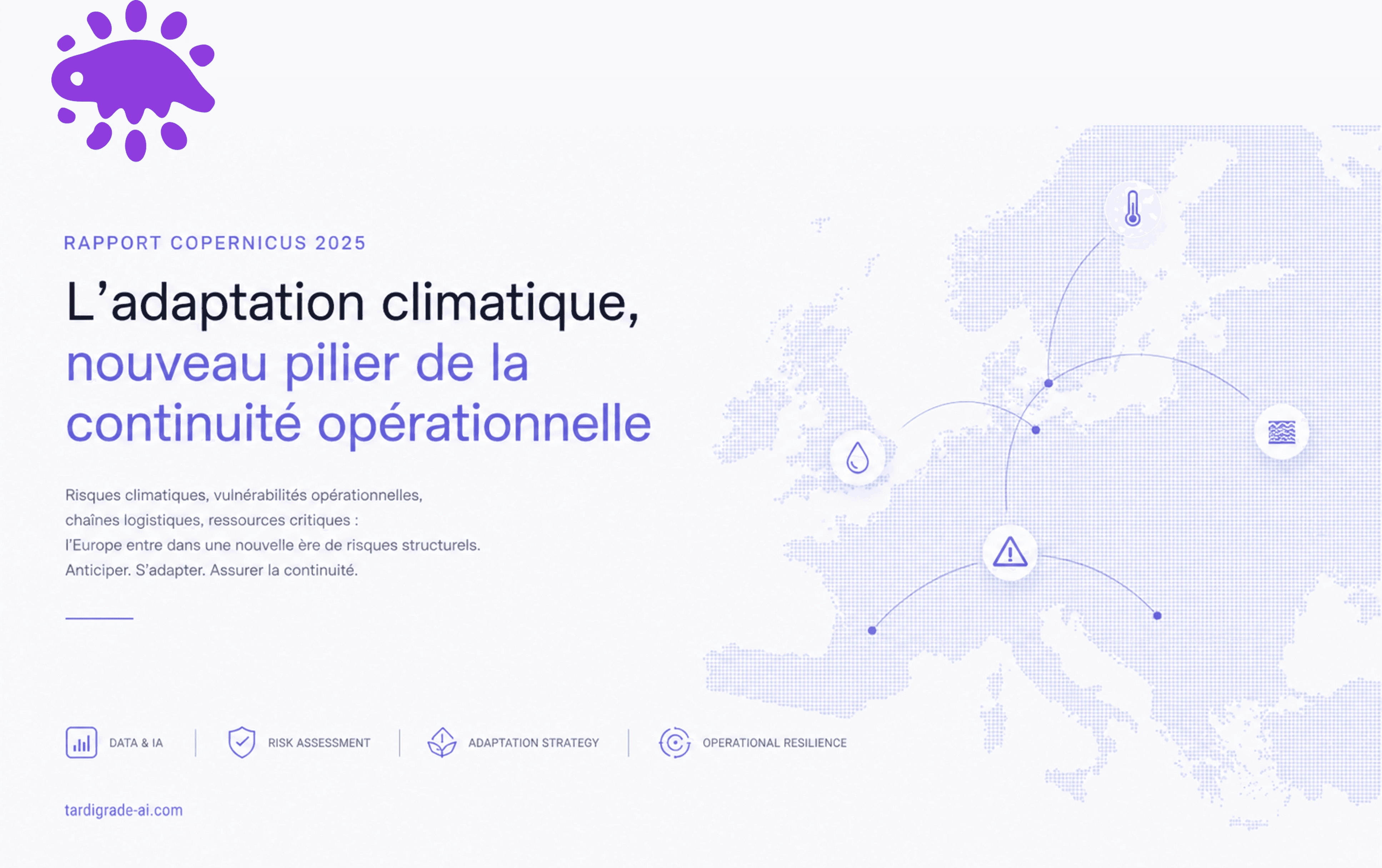
Executive summary
The European State of the Climate 2025 report, published jointly by Copernicus and the World Meteorological Organization (WMO), confirms that Europe is entering a critical phase of climate change. The continent is now experiencing faster warming than the global average, accompanied by an intensification of heatwaves, droughts, floods, and wildfires.
Beyond climate records, however, the report highlights a profound transformation in the operating conditions of European businesses. Climate hazards are no longer exceptional, isolated events. They are becoming structural factors of instability likely to permanently affect production capacities, critical infrastructure, water resources, supply chains, and working conditions.
For businesses, this evolution requires a paradigm shift. Approaches focused primarily on ESG reporting or decarbonization commitments now appear insufficient in the face of rising physical risks. The strategic question has now become operational: which companies will be able to maintain their activities in a European environment increasingly exposed to climate disruptions?
From this perspective, adaptation can no longer be considered a peripheral compliance issue. It is becoming a core challenge for operational continuity, industrial resilience, and economic competitiveness.
1. Europe is becoming an advanced laboratory for climate risk
The Copernicus report emphasizes that Europe is currently the fastest-warming continent in the world. In 2025, at least 95% of European territory experienced above-normal seasonal temperatures. Heatwaves even affected the subarctic regions of Scandinavia, with temperatures locally exceeding 30°C north of the Arctic Circle.
This development marks a major turning point for European economic actors. For a long time, climate change was perceived as a progressive and relatively distant risk for temperate European economies. Conversely, the report shows that European infrastructure, industrial systems, and territories are now entering a phase of direct exposure to historically unprecedented climate conditions.
This transformation does not only concern extreme events. It is progressively altering the normal operating conditions of economic systems: higher temperatures over longer periods, increased water stress, greater cooling needs, growing pressure on energy infrastructure, and deteriorating working conditions during summer periods.
For businesses, the question is therefore no longer simply whether an extreme event might occur, but how to maintain stable operations in an environment that has become structurally more unstable.
2. Heatwaves are becoming a systemic economic risk
One of the major findings of the report concerns the intensification of heat stress across the European continent. Several regions experienced prolonged heatwaves, with record temperatures and persistent tropical nights in multiple European countries.
For businesses, the consequences extend far beyond health concerns. Extreme heat directly affects the operational capacities of infrastructure and production systems. Industrial sites are seeing their energy needs surge due to cooling systems. Sensitive equipment is becoming more vulnerable to thermal failures. Working conditions are deteriorating, leading to productivity losses, increased safety risks for employees, and sometimes temporary operational shutdowns.
One of the main risks lies in the chronic and cumulative nature of these impacts. Unlike visible, one-off disasters, repeated heatwaves cause a gradual erosion of operational performance.
A few additional weeks of intense heat can be enough to permanently weaken supply chains, increase energy costs, and reduce a site's overall productivity.
This shift fundamentally challenges the historical design standards of European industrial buildings, logistics infrastructure, and energy systems, which were largely engineered for a climate that is now obsolete.
3. Water risk is becoming a major factor of industrial vulnerability
The report also highlights the intensification of droughts and water stress in several European regions. This trend poses a critical challenge for many industrial sectors that are heavily dependent on water for their production processes, cooling systems, or processing operations.
Yet, a large portion of companies continue to approach water issues primarily from the perspective of consumption or environmental compliance. However, the real issue is becoming the actual operational dependence of activities on water availability.
Two industrial sites may have similar consumption levels while having radically different vulnerability levels. Some will be able to maintain operations under degraded water conditions; others will quickly become unable to function normally in the event of usage restrictions or a lasting decline in available resources.
In a context of growing competition among industrial, agricultural, and urban uses, this issue becomes strategic. Access to water could gradually become a decisive factor in industrial location and territorial economic resilience.
4. European infrastructure and supply chains are entering a phase of chronic vulnerability
The report also highlights the surge in extreme events simultaneously affecting multiple European regions: floods, storms, wildfires, and extreme heat episodes.
This evolution is fundamentally transforming the nature of the risk facing European supply chains. Historically, resilience strategies were based on a logic of geographical diversification and logistical redundancy.
However, climate disruptions now tend to simultaneously affect multiple critical infrastructures and several interdependent territories.
During a single season, companies may face rail disruptions due to high heat, river navigation restrictions caused by drought, floods disrupting logistics hubs, or wildfires impacting energy and transport infrastructure.
This growing synchronization of vulnerabilities calls into question logistics models optimized for the climate stability of the 20th century. It demands a fresh look at value chain robustness, redundancy capabilities, and the territorial resilience of critical infrastructure.
5. Adaptation is becoming a strategic competitiveness issue
The Copernicus report implicitly underlines a fundamental transformation: climate change is gradually becoming a structural factor of economic competitiveness.
In this context, the most resilient companies will likely not be those that produce the most sophisticated climate reports, but those capable of precisely identifying their operational vulnerabilities and tangibly adapting their infrastructure, supply chains, and operating models.
Adaptation can no longer be reduced to a compliance exercise or a few ad hoc protective measures. It now requires a detailed understanding of organizations' critical dependencies: water dependency, thermal vulnerability of infrastructure, logistics exposure, energy resilience, asset sensitivity to business interruptions, or the capacity of territories to absorb repeated climate shocks.
This evolution also entails a transformation of investment strategies. Decisions regarding industrial facility location, building design, asset management, or supply chain security will increasingly need to incorporate future climate constraints.
Conclusion
The European State of the Climate 2025 report marks an important milestone in the understanding of climate risk in Europe. It shows that the continent is entering a phase where the physical impacts of climate change are becoming directly visible in economic systems and operational infrastructure.
For European businesses, the challenge now extends far beyond the scope of climate reporting or regulatory compliance. The central question is becoming the capacity to maintain robust operations in a deeply transformed physical environment.
In this new climate reality, adaptation is becoming a major strategic lever for resilience and competitiveness. Companies capable of anticipating their critical vulnerabilities and integrating climate constraints into their operational decisions will likely hold a decisive advantage in the European economy of the coming decades.
Link to the report: https://library.wmo.int/viewer/69848/download?file=Europe-State-Climate-2025_en.pdf&type=pdf&navigator=1
About Tardigrade AI
Anticipate, measure, decide
Tardigrade AI helps businesses move from climate risk to decision-making: forecasting events that threaten their operations, quantifying their cost, and choosing the most cost-effective adaptation measures.
Protect
5-day operational alerts
Anticipate heat, cold, wind, rain, hail, or snow up to 5 days in advance. An alert is only sent if a critical threshold for your business, your sites, or your teams is about to be exceeded.
Short term
Horizon
Cost of inaction and adaptation plan
Quantify in euros the climate impact on each of your sites or across your portfolio, then identify the most cost-effective adaptation measures from a catalog of 62 quantified solutions.
Long term