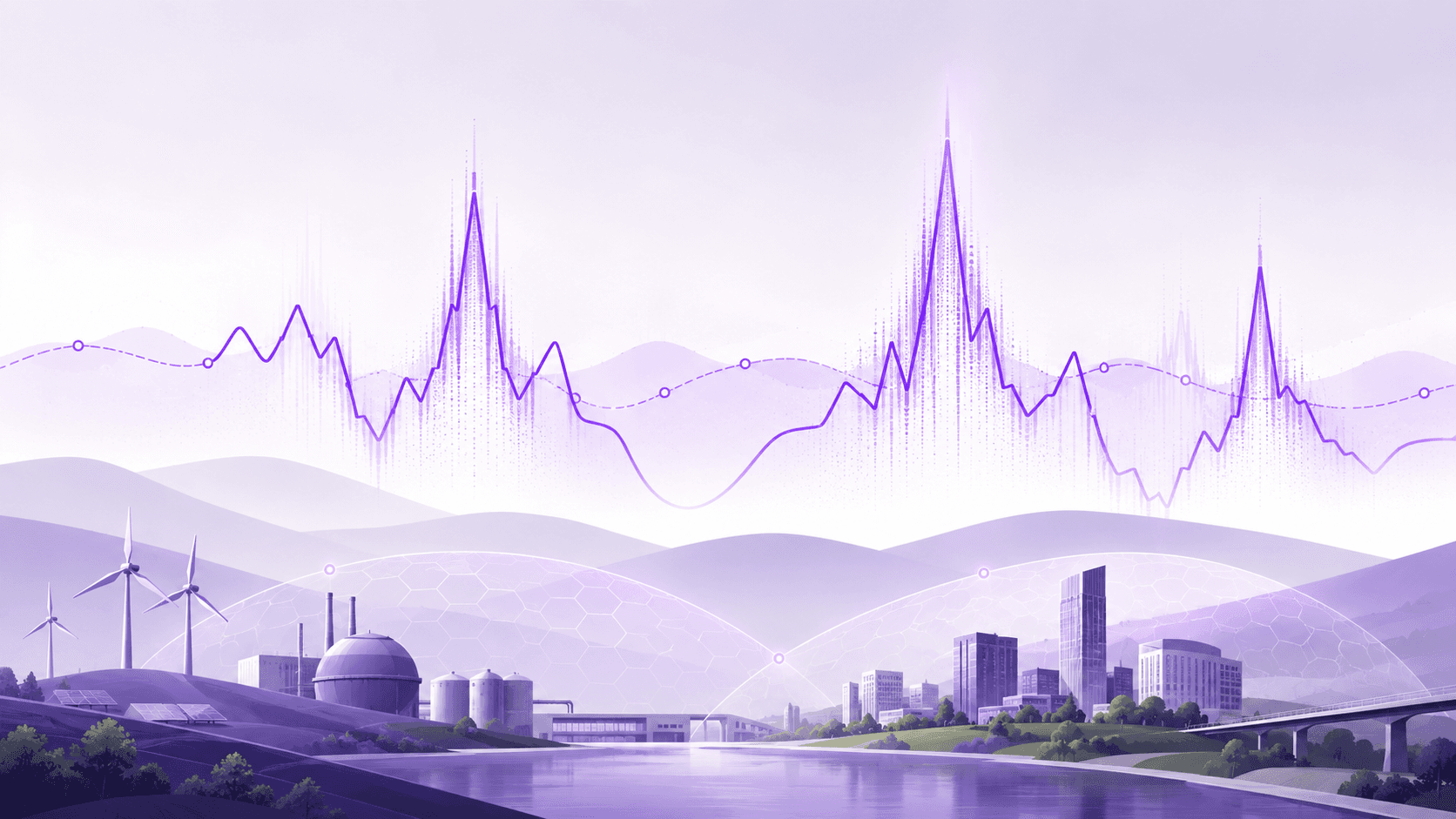
In adaptation, we prepare for gusts, not average winds
In recent days, many commentators have welcomed the gradual phasing out of the SSP5-8.5 scenario as the core scenario for future CMIP7 exercises and upcoming IPCC reports. In some media outlets, the message is sometimes simplistically summarized as: "the IPCC's alarmist scenarios were exaggerated" or "+4 or +5°C scenarios are no longer credible."
Above all, this sequence of events reveals a deep and widespread confusion about what climate scenarios actually are, their usefulness, and their role in adaptation strategies.
Behind this controversy lie several major misunderstandings: the confusion between scenario and forecast, between mitigation and adaptation, between climate average and extreme risk, between probability and decision-making relevance, but also between the climatological horizon and the real economic horizon of businesses.
And these confusions are not benign. On the contrary, they risk fostering a dangerously simplified reading of physical climate risks at the very moment when they are becoming a major operational, financial, and asset management challenge.
A climate scenario is not a weather forecast for the century
The first problem is probably the most fundamental: the IPCC does not "forecast" the future.
The IPCC does not produce weather forecasts with a 2100 horizon. It analyzes conditional trajectories built on socio-economic, technological, demographic, and energy assumptions. In other words, a climate scenario is not a prophecy. It is a strategic thinking tool based on assumptions.
The problem is that public debate, the media, and sometimes even certain companies end up confusing a scenario with a probabilistic forecast. Yet they are not at all the same thing.
SSP scenarios describe possible worlds, not certain futures. They serve to explore plausible trajectories in order to test the robustness of societies, infrastructure, economies, and assets against different levels of warming.
In this context, SSP5-8.5 never meant: "this is exactly what will happen." Rather, it means: "this is what could happen in a world characterized by very high emissions and heavy dependence on fossil fuels."
The nuance is essential.
Abandoning SSP5-8.5 as a core scenario does not make the risks disappear
The fact that SSP5-8.5 is now considered less likely as a core trajectory absolutely does not mean that the associated risks disappear.
On the contrary. Extreme events, tipping points, climate feedbacks, economic constraints, or systemic effects can locally produce impacts comparable to those historically associated with the highest emissions scenarios.
And above all, global greenhouse gas emissions have still not started to decrease at the global scale. Until proven otherwise, the physical logic underlying SSP5-8.5 (rising atmospheric concentrations and energy accumulation in the climate system) has not vanished.
There is also another rarely mentioned methodological weakness: many scenarios implicitly assume a relatively "functional" global economy, capable of pursuing the energy transition under relatively stable conditions. Yet the physical impacts of climate change themselves could disrupt political stability, investment capacities, and the very ability of societies to drive the transition. Decarbonizing in the climate of 2020 will probably not be the same as decarbonizing in the climate of 2050 or 2080. This issue is rarely explicitly integrated into transition scenarios.
In adaptation, the question is not "which scenario is the most likely?"
This is probably the most misunderstood point in the current debate.
In the field of adaptation, the relevance of a scenario does not depend solely on its average probability. It also and above all depends on its ability to test the robustness of an asset or a business in the face of degraded situations.
In finance, insurance, or engineering, robust strategies are never built solely on average assumptions. You don't size a dike based on the average flow of a river. You don't manage a bank solely on the central economic scenario. And in climate adaptation, you don't size an asset for average winds, but for gusts.
In other words, what matters is not only the scenario's average, but an asset's ability to withstand plausible extreme situations.
In this logic, SSP5-8.5 retains major utility as a stress scenario, a useful upper bound, a robustness tool, and a resilience test. Even if its average probability decreases, its value for testing systemic vulnerabilities remains considerable.
Companies do not reason with a 2100 or 2150 horizon
Another major confusion concerns time horizons.
Much of the public debate on climate scenarios focuses on very distant horizons like 2100 or even 2150 with upcoming new scenarios. But in the real world of operational adaptation, very few decisions are made over such distant horizons.
A real estate director, a property company, a data center operator, an industrialist, or a retailer primarily reason over 5, 10, 20, or sometimes 30 years. That is, the horizon of return on investment, financing, depreciation, asset holding, or insurance.
Yet until around 2040–2050, the differences between scenarios remain relatively limited compared to local physical uncertainties, natural variability, and especially differences in vulnerability between assets.
In other words, in many cases, the main adaptation challenge is not knowing whether the planet will be at +2.7°C, +3.2°C, or +5°C in 2100. The primary issue is rather local vulnerability, exposure to extremes, business continuity, operational resilience, insurance costs, cooling needs, water stress, business interruption losses, and the ability to maintain the asset value.
The real danger: believing that risk decreases because a scenario becomes less central
The risk today is not that climate scenarios are "too alarmist."
Rather, the risk is turning a complex methodological debate into a false sense of security. Because physical risks continue to increase. Record temperatures are multiplying, insurance costs are skyrocketing (or more precisely, insurers are dropping coverage for at-risk assets to maintain their generous dividends), extreme events are becoming more frequent, adaptation needs are increasing, and the vulnerability of infrastructure remains considerable.
The fact that certain very high scenarios are becoming less likely as central pathways does not change this fundamental reality.
In adaptation, the question is not just: "which future is most likely?"
The real question is rather: "which plausible futures must our assets, our infrastructure, and our business models be able to withstand?"
And from this perspective, extreme scenarios, including SSP 5-8.5, remain not only useful, but indispensable.
About Tardigrade AI
Anticipate, measure, decide
Tardigrade AI helps businesses move from climate risk to decision-making: forecasting events that threaten their operations, quantifying their cost, and choosing the most cost-effective adaptation measures.
Protect
5-day operational alerts
Anticipate heat, cold, wind, rain, hail, or snow up to 5 days in advance. An alert is only sent if a critical threshold for your business, your sites, or your teams is about to be exceeded.
Short term
Horizon
Cost of inaction and adaptation plan
Quantify in euros the climate impact on each of your sites or across your portfolio, then identify the most cost-effective adaptation measures from a catalog of 62 quantified solutions.
Long term