Physical Climate Risks: Who Measures the Risk, and for Whom?
Behind an April Fools' joke about a reform of the coverage for drought-induced clay shrinkage and swelling (RGA) risk lies a much more serious reality: the insurance model is changing. As climate losses increase, insurers adapt their practices, become more selective about risks, and strengthen their profitability. But what, then, are the risk estimates they produce for their clients really worth? Between selection bias and the illusion of precision, one question inevitably arises: can an insurer still be considered a neutral reference for assessing climate risk?
On April 1st, a fictitious reform of the natural disaster (CatNat) scheme applied to the shrinkage and swelling of clay soils circulated on LinkedIn. It described a system in which every real estate property would be evaluated individually using satellite data, sensors, and algorithms, with direct consequences for pricing, compensation, and even access to insurance.
Presented as a joke, this proposal nonetheless sparked unease. Not because it was absurd, but because it appeared, in many respects, to be a barely exaggerated extrapolation of trends already underway.
A System Under Pressure, Sharply Rising Losses
Since the early 2020s, economic losses from natural disasters have reached historically high levels. They now regularly exceed $250 to $300 billion per year, with the insured share limited to about 40% (Swiss Re Institute, 2024; 2025). The rest—the majority of the damage—is borne directly by policyholders or public finances.
This disparity, known as the “protection gap,” is widening as climate change alters the frequency, intensity, and nature of extreme events. The IPCC emphasizes that these developments are accompanied by an increase in correlated and systemic risks, which challenge traditional risk-pooling mechanisms (IPCC, 2022).
In this context, public systems themselves are showing signs of strain. In France, the reserves of the CatNat scheme were virtually depleted between 2020 and 2023, illustrating the difficulty of absorbing repeated climate losses.
A Puzzling Paradox: Rising Losses, Rising Profits
Examining recent data together reveals a tension that is difficult to ignore. On the one hand, climate losses—both insured and especially uninsured—have followed a distinctly upward trajectory since the beginning of the 2020s. On the other hand, major European insurance groups have reported sharp net profit growth over the same period, amounting to billions of euros in additional gains.
The graph presented in this article illustrates precisely this dynamic. Indexed to base 100 (2020), the profits of major players such as AXA, Allianz, and Zurich grew strongly over the 2020–2025 period, with multiplier coefficients ranging from ×1.6 (Allianz) to ×3.3 (AXA), while global climate losses continue to rise and the uninsured share now exceeds 50% (Figure 1).
This observation calls for several remarks.
First, it invalidates the intuitive assumption that an increase in climate losses would automatically translate into a deterioration in insurer performance. In reality, insurers do not passively endure risk: they reshape it. Raising premiums, increasing deductibles, reducing coverage, and withdrawing from certain areas or specific perils make it possible to maintain—or even improve—profitability, despite an increasingly adverse physical environment.
Second, this widening gap between economic losses and insurance financial results reflects a transfer of risk. The simultaneous increase in profits and the “protection gap” indicates that a growing share of losses is being shifted off insurers' balance sheets onto policyholders themselves or onto public finances. In other words, the financial performance of the sector no longer directly mirrors changes in physical risk, but rather its ability to select and reconfigure its exposure.
Third, and this is undoubtedly the most fundamental point, this paradox calls into question the very nature of the information produced by insurers. If damage functions, risk metrics, or climate models are calibrated using insured portfolios—themselves the outcome of selection processes—then they describe less an objective reality of risk than an economically filtered subset. In a context where profits are rising even as overall losses intensify, it becomes legitimate to wonder whether these assessment tools capture risk as it truly is, or as it is accepted.
This point directly echoes insights from the economic literature on insurance markets. As Einav and Finkelstein (2011) and later Einav (2021) demonstrate, the data observed in these markets are endogenous to selection mechanisms. They do not provide a neutral snapshot of risk, but rather the result of an equilibrium between pricing, underwriting, and exclusion. Consequently, using these data to build risk models amounts, in part, to reproducing the biases that generated them.
Finally, this divergence between physical dynamics and financial dynamics raises a more fundamental question: what does it mean to “accurately measure risk” in a world where those producing the information have a direct stake in how that risk is defined, segmented, and valued?
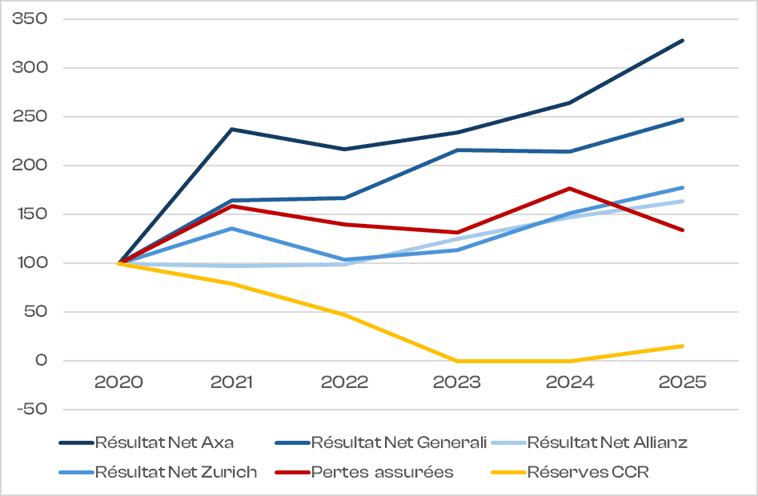
Figure 1: Evolution of net income, insured losses, and reserves of the Caisse Centrale de Réassurance – base 100 = 2020.
Who Evaluates the Risk? A Question Far from Neutral
In this new context, the question of risk assessment becomes central. Today, numerous actors—insurers, reinsurers, specialized consulting firms—offer climate risk analysis tools.
For a policyholder, the natural instinct is to turn to well-established players, particularly insurers themselves. Their expertise, access to data, and reputation serve as apparent guarantees of credibility.
Yet this trust deserves careful scrutiny.
An insurer is not a neutral observer of risk. By definition, they have a vested interest. Their business model relies on risk selection, pricing, and management. The data they use most often originate from their own portfolio—that is, from a universe already filtered by decisions to accept, reject, or exclude.
Recent economic literature consistently shows that the information produced in these markets is endogenous to these selection mechanisms. Ever since the seminal work of Einav and Finkelstein (2011), expanded by Einav (2021), insurance markets have been analyzed as “selection markets,” where the observed data do not describe risk as a whole, but only the portion retained after screening.
More recently, research incorporating behavioral frictions has shown that real-world markets combine selection and inertia, further complicating the interpretation of claims data (Croes et al., 2025). Finally, the rise of data technologies and artificial intelligence, far from eliminating these biases, could instead enhance insurers' ability to refine risk selection, thereby deepening information asymmetries (Zhang & Zhang, 2025). In this context, damage functions or risk metrics calibrated on insured portfolios reflect not so much an objective physical reality as an economic equilibrium resulting from selection decisions, which calls into question their use as an independent benchmark for climate risk assessment.
In the case of climate risks, this bias is amplified. Damage functions are often calibrated on observed claims, which themselves stem from selected portfolios. They therefore reflect a partial reality—that of accepted risk—and not necessarily that of physical risk as a whole.
The Illusion of Neutrality: The Weight of Name and Reputation
The situation is all the more delicate because the brand name and reputation of major industry players provide a sense of reassurance. When a renowned insurer produces an estimate, it tends to be accepted as a benchmark, often without in-depth questioning. It is seen, by definition, as reliable.
Yet this perception is partly rooted in confusion.
Model sophistication, team caliber, or data depth are not enough to ensure the neutrality or accuracy of the analysis. They may even reinforce an illusion of precision, when the results remain constrained by economic, regulatory, and strategic assumptions.
When these players simultaneously report strong profit growth against a backdrop of increasing climate losses, the question must be asked: is the risk assessment designed to reflect physical reality, or to serve a selection and pricing strategy?
The Insurer Is Not the Alpha and Omega of Risk Assessment
Another element must be stated clearly: in the realm of climate risk, there is no single, indisputable, and universal measure of risk. The estimates produced vary substantially depending on the models, underlying assumptions, datasets, and damage functions used. For the same asset, it is not uncommon to see significant discrepancies between different assessments.
This dispersion is neither marginal nor abnormal. It is widely documented in academic and professional literature. Ranger et al. (2022) demonstrate that climate risk models can yield divergent outcomes due to uncertainties regarding hazards, exposures, and vulnerabilities. The NGFS (2024) also notes that climate scenarios should be interpreted as exploratory frameworks providing orders of magnitude, rather than precise predictions. In the insurance sector, the Geneva Association (2022) stresses that catastrophe loss estimates structurally differ between players depending on calibration choices and reference portfolios.
In this context, turning to an insurer to obtain a risk estimate might seem like a natural reflex. Reputation, data depth, and model sophistication can create the feeling of accessing some form of absolute truth about the risk.
Yet this perception warrants nuance.
As mentioned earlier, an estimate produced by an insurer is inseparable from its economic framework. It is built upon selected portfolios, prudential constraints, and underwriting strategies. It therefore reflects one perspective on risk—informed and useful, but situated. By construction, it does not constitute a neutral or comprehensive benchmark of physical risk.
Consequently, the idea that an insurance estimate is inherently more accurate or reliable than another becomes debatable. It rests more on perceived authority than on any intrinsic superiority of the measurement.
Conversely, an independent approach based on explicit methodologies, transparent assumptions, and, where applicable, the comparison of multiple models, can provide a perspective on risk that is at least as relevant for decision-making. Not because it is perfect, but because it is partially free from the biases linked to selection and the economic constraints specific to the insurance industry.
This point is crucial for policyholders. In an uncertain environment, value lies not in illusory precision, but in having access to reliable, comparable, and actionable orders of magnitude. As demonstrated by Kousky and Kunreuther (2018) as well as the OECD (2023), even imperfect risk estimates help guide decisions, prioritize investments, and weigh different adaptation strategies.
Between knowing nothing and having an average estimate, the difference is substantial—especially for decision-making.
In other words, in a world where assessments are inevitably dispersed, the issue is not determining which estimate is “the true one,” but which is most useful for decision-making. From this perspective, an independent, transparent, and robust estimate often offers a sounder foundation than a single, however sophisticated, estimate produced within a framework where the entity measuring the risk is also the one selecting and pricing it.
An Illuminating Analogy: The Doctor and the Manufacturer
A simple analogy helps grasp the full implications.
When a person falls ill, they do not instinctively turn to a pharmaceutical company to obtain a diagnosis. They see a doctor. The doctor provides an independent diagnosis and then recommends a course of treatment, if necessary.
This separation is essential. It is specifically designed to prevent an entity with a direct financial stake in the solution from also being the one defining the problem.
Applied to the domain of climate risk, this logic encourages distinguishing between two functions: risk assessment and risk transfer. Entrusting both functions to the same entity means accepting that a diagnosis could be influenced, even implicitly, by economic considerations.
What Is at Stake for Policyholders: Regaining a Reliable View of Risk
In an environment characterized by rising losses, the erosion of risk pooling, and a growing protection gap, the challenge for policyholders is clear: obtaining as accurate a risk estimate as possible.
Yet a biased estimate—even slightly—can have significant consequences. It can lead to underestimating certain risks, overinvesting in others, or making inappropriate adaptation decisions.
In this context, an independent approach relying on a transparent and robust methodology emerges as an essential requirement. Not only to improve the quality of information, but also to prevent that information from being used against the party producing it, such as during pricing or contract renewals.
As several recent studies emphasize, the rise in climate risk comes with an increased need for transparency and standardization in exposure assessment (Ranger et al., 2022; NGFS, 2024).
A Silent Paradigm Shift
What the April Fools' joke about the RGA subtly reveals is a paradigm shift. Insurance is not disappearing, but its nature is changing. It is becoming more selective, more segmented, and, in some cases, more restrictive.
In this new framework, policyholders can no longer simply transfer risk. They must be equipped to understand, assess, and manage it.
This shift in the center of gravity is probably one of the most significant transformations in the contemporary insurance system.
Conclusion
April 1st brought a smile to our faces. Above all, however, it brought to light a clear reality: the insurance world is being reshaped by climate change.
In this context, the issue is no longer just about access to insurance, but about the quality of risk information.
And perhaps the most important lesson is this: in an uncertain world, trust can no longer rely solely on a brand name or reputation, no matter how established. It must rest on the independence of the diagnosis.
Because, just as in medicine, the quality of the treatment depends first and foremost on the quality of the diagnosis.
References
Croes, R., et al. (2025). Adverse selection and consumer inertia in health insurance markets. The European Journal of Health Economics.
Einav, L., & Finkelstein, A. (2011). Selection in insurance markets: Theory and empirics in pictures. Journal of Economic Perspectives, 25(1), 115–138.
Einav, L. (2021). The industrial organization of selection markets. In Handbook of Industrial Organization (Vol. 5). Elsevier.
Geruso, M. (2017). Selection in health insurance markets and its policy remedies. Journal of Economic Perspectives, 31(4), 197–218.
van Kleef, R. C., et al. (2024). Scope and incentives for risk selection in competitive health insurance markets. Medical Care Research and Review.
Zhang, Y., & Zhang, Y. (2025). Generative AI and information asymmetry in insurance markets. arXiv preprint.
Zwart, G. (2025). Moral hazard and risk adjustment. Journal of Economic Dynamics and Control.
EIOPA. (2024). The impact of climate change on non-life insurance demand and supply. European Insurance and Occupational Pensions Authority.
Geneva Association. (2023). Insurability in a changing climate: Evolving perspectives and challenges. Geneva: The Geneva Association.
IPCC. (2022). Climate Change 2022: Impacts, Adaptation and Vulnerability. Contribution of Working Group II to the Sixth Assessment Report. Cambridge University Press.
Kousky, C., & Kunreuther, H. (2018). Managing flood risk in the United States: The role of insurance. Risk Management and Insurance Review, 21(2), 213–241.
Kousky, C. (2023). Financing flood losses: A discussion of the National Flood Insurance Program. Annual Review of Resource Economics, 15, 379–398.
Ranger, N., Mahul, O., & Monasterolo, I. (2022). Assessing financial risks from physical climate change: A review of approaches. Climate Risk Management, 37, 100419.
Swiss Re Institute. (2024). Natural catastrophes in 2023: Global insured losses reach USD 108 billion. Sigma Report No. 1/2024.
Swiss Re Institute. (2025). Natural catastrophes: Protection gap remains high amid rising losses. Sigma Report No. 1/2025.
The Geneva Association. (2022). Climate change risk assessment for the insurance industry. Geneva.
NGFS (Network for Greening the Financial System). (2024). Climate scenarios for central banks and supervisors: Phase IV.
OECD. (2023). Responding to rising climate risks: Insurance and adaptation policies. Paris: OECD Publishing.
About Tardigrade AI
Anticipate, measure, decide
Tardigrade AI helps businesses move from climate risk to decision-making: forecasting events that threaten their operations, quantifying their cost, and choosing the most cost-effective adaptation measures.
Protect
5-day operational alerts
Anticipate heat, cold, wind, rain, hail, or snow up to 5 days in advance. An alert is only sent if a critical threshold for your business, your sites, or your teams is about to be exceeded.
Short term
Horizon
Cost of inaction and adaptation plan
Quantify in euros the climate impact on each of your sites or across your portfolio, then identify the most cost-effective adaptation measures from a catalog of 62 quantified solutions.
Long term