How Early Warning Systems Turn Risk Awareness into Concrete Action
Heatwaves, floods, droughts, storms: extreme weather events are multiplying, and scientific knowledge about their causes and consequences has never been more abundant. Despite IPCC reports, risk assessments, new regulatory requirements, and an accumulation of lessons learned, adaptation investments are progressing more slowly than the risks themselves.
This paradox intrigues and frustrates. Why do perfectly informed organizations continue to react rather than act? Why does risk awareness not systematically translate into concrete decisions?
What if understanding the mechanisms that hold back action actually made it possible to accelerate adaptation? What if monitoring and early warning systems represented the first, immediate step—the simplest, most concrete, and most cost-effective step toward your climate resilience strategy?
The Paradox of Climate Inaction
For more than twenty years, knowledge about climate risks has progressed at a remarkable pace. Today, organizations have access to information that previous generations simply did not have: climate projections, exposure maps, vulnerability analyses, climate stress tests, evolution scenarios, and increasingly precise regulatory requirements.
Yet, research devoted to adaptation reveals a more nuanced reality. The seminal work of Moser and Ekstrom (2010) shows that the primary barriers to adaptation rarely appear during the risk comprehension stage. Instead, they emerge during the phases of prioritization, trade-offs, resource allocation, or operational implementation. In other words, understanding a risk is not enough to act on it. More recently, Benischke et al. (2025) demonstrated that adaptation research has entered a new phase. The main challenge is no longer to produce more climate information, but to transform available knowledge into operational decisions and concrete actions. The authors now speak of a true knowledge-action gap.
Why Our Brain Pushes Us to Wait
Behavioral sciences help shed light on our understanding.
The first is the availability heuristic, described as early as 1973 by Tversky and Kahneman. We spontaneously assess the probability of an event based on our ability to recall it. After a heatwave or a flood, the risk seems obvious. Meetings multiply, projects emerge, and budgets become easier to secure. A few months later, attention shifts to other topics, even as risk exposure remains unchanged or even increases.
The second explanation comes from the work of Elke Weber (2006, 2010). In her finite pool of worry theory, our capacity to worry about multiple risks simultaneously is limited. Inflation, cybersecurity, artificial intelligence, geopolitical tensions, budget constraints: all these concerns compete for decision-makers' attention. Climate risk does not disappear, but it gradually ceases to be a priority.
A third explanation lies in what disaster management specialists call normalcy bias. We naturally tend to believe that tomorrow will look like yesterday. Even when we acknowledge the existence of a risk, we often continue to implicitly assume that it will remain exceptional and that everything will return to normal. This tendency is obviously problematic in a climate context, where past statistics are becoming progressively less representative of future conditions, and where the future climate no longer resembles the past climate.
The Problem Isn't the Risk. It's the Lack of a First Step.
One of the most important contributions of recent literature concerns understanding the mechanisms that actually trigger action.
The Protection Motivation Model developed by Rogers (1975, 1983) shows that the decision to act rests on two complementary assessments. The first concerns the perception of the threat. The second concerns the perception of response efficacy. In other words, organizations act when they simultaneously consider that a risk is real AND that an effective solution exists to address it.
This distinction is fundamental. A company can be fully convinced that heatwaves, floods, or droughts represent serious threats without actually initiating an adaptation process if it believes that the available solutions are too complex, too costly, or too difficult to implement. The work of Grothmann and Patt (2005), followed by Ouertani et al. (2025), confirms this intuition. The perception of solution efficacy and the perceived ability to implement them are more decisive factors than risk perception itself.
Why Early Warning Systems Change the Dynamics
While researchers today agree on the mechanisms that hold back action, one question remains: how do we shift this balance? How do we transform an organization that endures into an organization that anticipates?
The literature on adaptation provides a particularly interesting lesson. Organizations do not move from inaction to a full-fledged adaptation strategy overnight. They advance in successive steps. A first project leads to an initial set of lessons learned. This feedback generates new actions that are easier to justify, and so on.
In other words, adaptation does not begin with the most complex or costly investments. It begins with an initial concrete action capable of demonstrating that anticipation generates value.
The question is no longer how to convince organizations that risks exist. It is about offering an initial solution capable of creating that first momentum, integrating present risk into daily decision-making, and progressively transforming knowledge into action. This is precisely where early warning systems take on their full significance. Research from the Grantham Research Institute at the London School of Economics (2024) shows that the value of monitoring and early weather warning systems is not the information per se, but its ability to trigger preventive actions before an event occurs. The goal is not information, but action. More recent work by Reichstein et al. (2025) points in the same direction. The next generation of warning systems must be multi-hazard, user-oriented, and directly designed to support decision-making. A system's performance is no longer measured solely by its predictive accuracy, but by its ability to influence behavior. This evolution is perhaps even better summarized by Lim (2026), who suggests shifting from a logic of alerts disseminated to one of actions executed. The true indicator of success is not the number of alerts sent, but the number of protective actions actually triggered and the damages avoided.
From Information to Decision: What a Modern Early Warning System Really Is
Once exposure and vulnerability diagnostics are completed, many organizations still perceive adaptation as a series of complex projects: building reinforcement, flood protections, equipment modernization, asset relocation, or resilience investments that can be heavy and costly. These measures will often be necessary. But adaptation literature also shows that organizations rarely commit to major transformations in a single leap. Action more frequently emerges gradually, through concrete experiences that reinforce risk perception, confidence in available solutions, and the feeling of being able to act effectively (Grothmann & Patt, 2005; Berkhout, 2012; Benischke et al., 2025).
This is precisely the role that a modern early warning system can play.
When early warning systems are mentioned, many imagine a simple weather bulletin forecasting a storm, heatwave, or heavy rainfall event. A yellow, orange, or red color determined by local authorities for a region. Today, this vision is largely outdated.
A modern early warning system does not merely seek to forecast the weather at a GPS coordinate. Its goal is to turn a forecast into an operational decision. It no longer only answers the question: “What is going to happen?” but rather: “What perils do I need to take into account, what will be the consequences for my organization, and what actions should be implemented to mitigate their impacts?”
This evolution corresponds precisely to the vision advocated by Reichstein et al. (2025), for whom next-generation warning systems must be multi-hazard, user-centered, and designed to directly support decision-making. It also aligns with the work of Lim (2026), which suggests measuring a system's performance not by the number of alerts issued, but by the number of actions actually triggered.
In practical terms, a modern warning system combines several complementary building blocks: weather forecasting, local context awareness, vulnerability assessment, and the definition of preventive actions tailored to the identified risks. The objective is no longer to disseminate generic information, but to provide decision support that is directly actionable for operational teams.
Tardigrade AI's Early Warning System: Turning Knowledge into Action
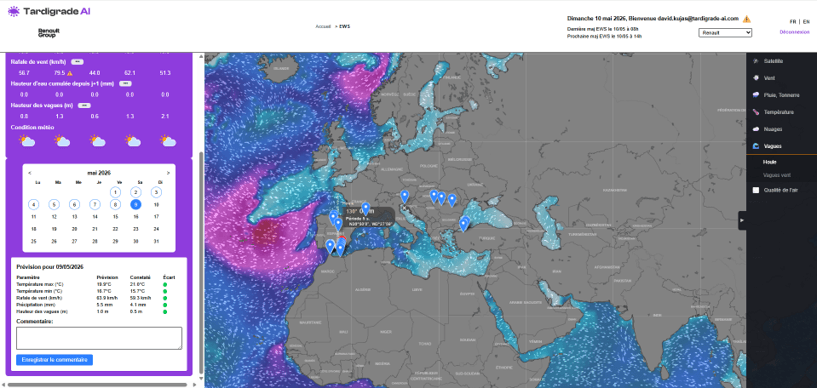
The Early Warning System (EWS) developed by Tardigrade AI does not stop at monitoring the weather. Its goal is to turn climate information into operational decisions. The platform provides continuous 24/7 monitoring of assets based on their exact GPS coordinates. For each site, up to twenty-two weather models are deployed simultaneously and evaluated by an artificial intelligence engine to build robust anticipation of climate hazards up to five days in advance, while reducing the uncertainties associated with using a single model.
The approach does not consist solely of detecting a meteorological phenomenon. It aims to determine whether this phenomenon genuinely represents a threat to a given asset. To achieve this, forecasts are cross-referenced with the local climate context, site characteristics, vulnerabilities identified during risk assessments, and operational thresholds specific to each organization. The same temperature, rainfall volume, or wind speed can thus lead to different alert levels depending on the assets involved, their exposure, and their operational sensitivity.
Each alert level is paired with concrete prevention and protection actions defined upstream with the relevant teams: securing personnel, protecting equipment, adapting operations, anticipating logistical disruptions, or preparing business continuity plans. The goal is no longer simply to know that an event is going to occur, but to have the necessary time to act before it brings about its consequences.
This approach aligns directly with the recommendations made by Reichstein et al. (2025). The next-generation EWS is no longer a simple forecasting tool, but a true multi-hazard, user-centered decision support system designed to drive action. This approach also aligns with the vision proposed by Lim (2026), according to which warning system performance should no longer be evaluated by the number of alerts sent, but by the number of actions actually triggered and the damages avoided.
Beyond immediate prevention, the EWS delivers a second, often underestimated benefit: it helps firmly embed climate risk within the organization's decision-making processes. Every alert, every preventive action, and every debriefing progressively strengthens the risk culture, improves the understanding of vulnerabilities, and facilitates future adaptation decisions. By reducing the effects of the availability bias, limiting the consequences of the finite pool of worry, and reinforcing the perception of action efficacy described by Rogers (1983), the system helps bridge the knowledge-action gap identified by Benischke et al. (2025).
In other words, the EWS does not replace adaptation; it creates the conditions that make it possible. Because it is simple to deploy, immediately operational, financially highly accessible, and a direct value creator, it often represents the first step—the most concrete, fastest, and most cost-effective—toward a more ambitious climate adaptation strategy.
References
Bandura, A. (1997). Self-Efficacy: The Exercise of Control. New York: W. H. Freeman.
Benischke, M. H., Williams, T. A., Shepherd, D. A., & York, J. G. (2025). Climate Change Adaptation: New Vistas for Management Research. Business & Society, 64(1), 3–39.
Berkhout, F. (2012). Adaptation to Climate Change by Organizations. Wiley Interdisciplinary Reviews: Climate Change, 3(1), 91–106.
Evensen, D., Whitmarsh, L., Bartie, P., & Devine-Wright, P. (2021). Effect of "finite pool of worry" and COVID-19 on UK climate change perceptions. Proceedings of the National Academy of Sciences, 118(3), e2018936118.
Grothmann, T., & Patt, A. (2005). Adaptive Capacity and Human Cognition: The Process of Individual Adaptation to Climate Change. Global Environmental Change, 15(3), 199–213.
Grantham Research Institute on Climate Change and the Environment. (2024). The Essential Role of Climate Information Systems for Early Action Interventions and Resilience-Focused Decision-Making. London School of Economics and Political Science.
Lim, B. (2026). From Early Warning Systems to Early Action Systems: Measuring Success through Action and Impact. International Journal of Disaster Risk Reduction (forthcoming).
Moser, S. C., & Ekstrom, J. A. (2010). A Framework to Diagnose Barriers to Climate Change Adaptation. Proceedings of the National Academy of Sciences, 107(51), 22026–22031.
Ouertani, E., Ghrab-Morcos, N., & Hadded, M. (2025). Beekeepers' Intentions to Adopt Resilience Strategies for Climate Change: An Application of Protection Motivation Theory. Frontiers in Climate, 7.
Reichstein, M., et al. (2025). Early Warning of Complex Climate Risk with Integrated Foundation Models. Nature Communications, 16.
Rogers, R. W. (1975). A Protection Motivation Theory of Fear Appeals and Attitude Change. The Journal of Psychology, 91(1), 93–114.
Rogers, R. W. (1983). Cognitive and Physiological Processes in Fear Appeals and Attitude Change: A Revised Theory of Protection Motivation. In J. Cacioppo & R. Petty (Eds.), Social Psychophysiology (pp. 153–176). New York: Guilford Press.
Tversky, A., & Kahneman, D. (1973). Availability: A Heuristic for Judging Frequency and Probability. Cognitive Psychology, 5(2), 207–232.
Weber, E. U. (2006). Experience-Based and Description-Based Perceptions of Long-Term Risk: Why Global Warming Does Not Scare Us (Yet). Climatic Change, 77(1–2), 103–120.
Weber, E. U. (2010). What Shapes Perceptions of Climate Change? Wiley Interdisciplinary Reviews: Climate Change, 1(3), 332–342.
About Tardigrade AI
Anticipate, measure, decide
Tardigrade AI helps businesses move from climate risk to decision-making: forecasting events that threaten their operations, quantifying their cost, and choosing the most cost-effective adaptation measures.
Protect
5-day operational alerts
Anticipate heat, cold, wind, rain, hail, or snow up to 5 days in advance. An alert is only sent if a critical threshold for your business, your sites, or your teams is about to be exceeded.
Short term
Horizon
Cost of inaction and adaptation plan
Quantify in euros the climate impact on each of your sites or across your portfolio, then identify the most cost-effective adaptation measures from a catalog of 62 quantified solutions.
Long term