Early climate warning: a strategic building block for adaptation and business continuity
The intensification of extreme weather events is progressively transforming operational risk management for businesses and infrastructures. Heatwaves, extreme rainfall, flash floods, violent winds, droughts, wildfires, wave height, or water stress now directly affect employee safety, equipment integrity, supply chains, and business continuity.
In this context, organizations are seeking to strengthen their climate adaptation strategies and resilience capabilities. Yet, one of the measures offering the best cost-benefit ratios today remains relatively under-deployed: geolocated early climate warning systems, or Early Warning Systems (EWS).
From weather information to operational decision-making
The primary function of an advanced climate warning system is not simply to indicate that a weather phenomenon is likely to occur. Its true purpose is to answer a much more operational question:
“At what point should protection, safety, or business continuity measures be triggered at a given site?”
This distinction is fundamental. A weather forecast describes an atmospheric phenomenon; a climate warning system seeks to assess the probability that an event will exceed critical thresholds likely to affect people, equipment, infrastructure, or operations.
The objective is therefore not only to predict a hazard, but to transform climate information into an actionable capability.
A few hours or days of anticipation can make it possible to:
Ensure employee safety;
Halt certain sensitive operations;
Protect critical equipment;
Relocate inventory or vehicles;
Anticipate power outages;
Mobilize service providers;
Find an alternative routing option;
Or activate a business continuity plan.
Implementing a monitoring and preventive warning system represents an insignificant cost compared to the potential losses avoided.
An adaptation measure with a very high return on investment
Early warning systems are now among the adaptation measures most strongly supported by international institutions. Work by the Global Commission on Adaptation, the World Bank, the World Meteorological Organization (WMO), and the United Nations regularly highlights the very high return on investment associated with early warning and anticipation mechanisms.
This logic is relatively intuitive: when a climate event cannot be prevented, the ability to anticipate it nevertheless allows its human, material, and financial consequences to be significantly reduced.
In a growing number of cases, the greatest losses do not result solely from the intensity of the event itself, but from the lack of operational anticipation. A logistical disruption, failure to secure critical equipment, a delay in activating a continuity plan, or poor team coordination can greatly amplify the impacts of an event that could have been anticipated hours in advance.
Climate warnings thus constitute one of the first concrete building blocks of an operational climate adaptation strategy.
The structural limitations of public vigilance and warning systems
In France, it is important to clearly distinguish meteorological vigilance from operational alerts, two concepts that are often confused but correspond to very different functions.
Meteorological vigilance is issued by Météo-France. It aims to inform authorities, the media, and the public that a potentially dangerous weather phenomenon is likely to occur in a given area. It serves as a national prevention and anticipation mechanism.
An alert, on the other hand, falls under the responsibility of administrative and civil protection authorities (primarily prefects and mayors), who decide, based on the available information, whether or not to trigger operational protection measures:
Activating ORSEC emergency plans;
Mobilizing emergency rescue services;
Placing teams on standby;
Evacuations;
Closing infrastructure;
Broadcasting emergency messages;
Or triggering FR-Alert.
In other words: Météo-France produces vigilance; public authorities decide on a potential alert.
This distinction is fundamental to understanding the structural limitations of public systems when it comes to protecting specific assets or industrial operations.
On the one hand, vigilance bulletins are primarily issued at the departmental scale, whereas the most damaging weather phenomena today (stationary thunderstorms, intense localized rainfall, convective gusts, hail, or flash floods) often exhibit extremely high spatial variability.
On the other hand, triggering a public alert is also an administrative, operational, and political decision. Each escalation of an alert level can result in:
Mobilizing emergency services;
Placing teams on standby;
Activating crisis units;
Business disruptions;
Preventive closures;
Or significant organizational costs.
Authorities must therefore constantly balance several risks:
Triggering an alert too early;
Triggering an alert unnecessarily;
Or triggering an alert too late.
In the most uncertain weather situations (especially during Mediterranean episodes, violent storms, or flash floods), this logic can naturally lead to waiting until the last moment before triggering heavy measures, in the hope that the phenomenon diminishes in intensity, shifts geographically, or does not ultimately materialize to the expected degree.
Even when a departmental vigilance is correctly issued, it may therefore still be insufficiently early, insufficiently localized, or insufficiently contextualized to allow an industrial operator, logistics provider, or critical infrastructure manager to effectively trigger their own safety or business continuity procedures.
This is precisely where geolocated climate warning systems become essential.
Unlike public mechanisms, their objective is not to manage a civil defense response across an entire territory, but to maximize the operational anticipation capacity of a specific site.
In other words, where public authorities must strike a complex balance between public protection, resource mobilization, and regional risk management, a business primarily seeks to answer a much more operational question:
“At what point should we trigger our own safety and business continuity measures?”
The emergence of AI-driven geolocated climate warning systems
Recent advances in artificial intelligence, distributed computing, and meteorological modeling now make it possible to develop much more precise and contextualized warning systems.
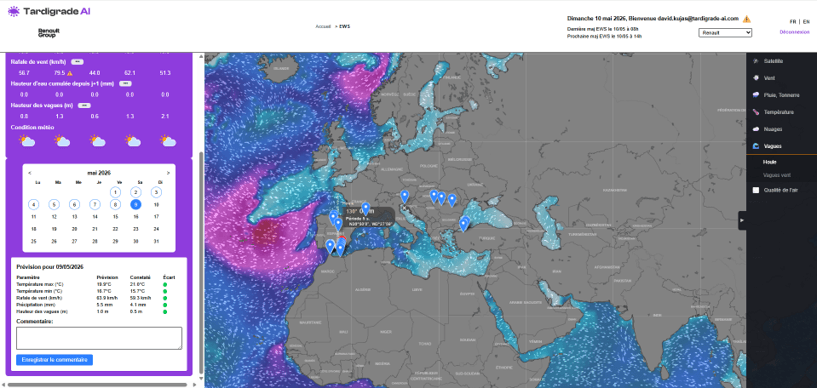
The approaches developed by Tardigrade AI rely on geolocated site monitoring and the continuous analysis of multiple international weather models operating around the clock.
In practice, an artificial intelligence component simultaneously leverages around twenty meteorological and climate models to identify, for each monitored site at a 10m resolution around the site, the models delivering the best performance based on:
The type of peril involved;
The time horizon;
Critical meteorological thresholds;
Local geographic characteristics;
And the specific vulnerabilities of the site.
Not all weather models perform equally across different phenomena. Some are more effective for extreme precipitation, others for violent winds, temperatures, convective phenomena, or specific forecast horizons.
This dynamic approach significantly improves warning relevance and limits false alarms.
From an operational perspective, this equates to having a form of specialized, continuous weather monitoring for each of an organization’s critical sites.
Alerts can thus be contextualized according to:
The peril involved;
The expected criticality level;
Internal trigger thresholds;
Specific vulnerabilities;
And associated continuity procedures.
From weather to operational physical risk
The major advantage of an advanced climate warning system lies in its ability to connect a meteorological phenomenon to its potential impacts on operations.
High temperatures will not have the same consequences whether they affect a data center, a construction site, an industrial facility, a logistics platform, or a healthcare facility. Similarly, an episode of heavy precipitation can generate very different impacts depending on local topography, drainage systems, basements, equipment on-site, or historical loss data. Or, excessively high wave heights can prevent a ferry from leaving port, significantly delaying the delivery of its cargo.
Advanced climate warning is therefore not simply about monitoring the weather. It aims to detect the moment a climate phenomenon is likely to become a significant operational risk.
This approach progressively aligns climate warning systems with contemporary frameworks for physical risk management, operational resilience, and business continuity.
An increasingly consistent component with regulatory frameworks
Recent regulatory frameworks (CSRD, ESRS E1, IFRS S2, the EU Taxonomy, or prudential recommendations) now push organizations to demonstrate their ability to identify, monitor, and manage physical climate risks.
In this context, early climate warning systems are progressively becoming:
Risk governance tools;
Building blocks of operational resilience;
Components of adaptation plans;
And instruments for reducing potential losses.
Climate adaptation does not rely solely on heavy capital investments or infrastructural transformations. In many cases, improving anticipation capabilities already represents a major lever for risk reduction.
As extreme events become more frequent and more costly, the ability to anticipate and act quickly is gradually becoming a decisive operational and strategic advantage.
Placing sites under monitoring before the next extreme event
Extreme climate events will continue to intensify over the coming decades. In this context, the question is no longer really whether an organization will face a major event, but rather whether it will have the necessary anticipation capabilities to limit its human, operational, and financial impacts.
Geolocated climate warning systems currently represent one of the first concrete building blocks of operational resilience that can be deployed quickly, often with an immediate return on investment.
Tardigrade AI develops early climate warning solutions that continuously monitor critical sites, infrastructure, and assets to anticipate weather events likely to affect operations and to facilitate the triggering of safety and business continuity measures.
To discuss placing your sites under monitoring or to test the capabilities of the Tardigrade AI climate warning system:
📩 contact@tardigrade-ai.com
About Tardigrade AI
Anticipate, measure, decide
Tardigrade AI helps businesses move from climate risk to decision-making: forecasting events that threaten their operations, quantifying their cost, and choosing the most cost-effective adaptation measures.
Protect
5-day operational alerts
Anticipate heat, cold, wind, rain, hail, or snow up to 5 days in advance. An alert is only sent if a critical threshold for your business, your sites, or your teams is about to be exceeded.
Short term
Horizon
Cost of inaction and adaptation plan
Quantify in euros the climate impact on each of your sites or across your portfolio, then identify the most cost-effective adaptation measures from a catalog of 62 quantified solutions.
Long term